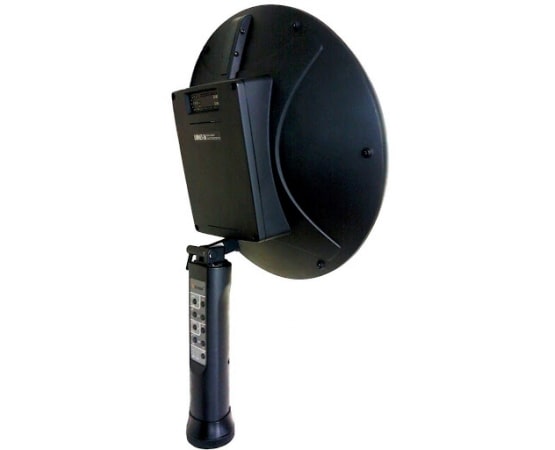
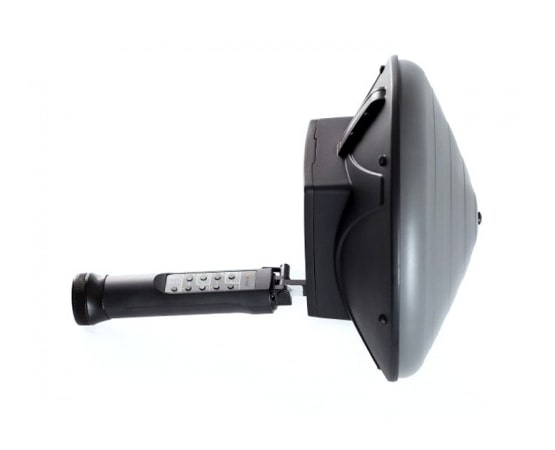
Distinctive features:
-
Thanks to the high frequency of the probing signal and an effectively implemented narrow antenna beam pattern, the LORNET 36 significantly surpasses all domestic and foreign nonlinear locators in terms of detection range, selectivity, and spatial localization accuracy of semiconductor elements. Specific examples: in terms of detection range of standard simulators (tags) for the NGO ORION nonlinear locator, the LORNET 36 is at least 3 times superior to the imported device; when the distance between tags is less than 30 cm, the imported device does not see the 3rd harmonic simulator due to the masking effect of the 2nd harmonic simulator, while the LORNET 36 detects and discriminates both tags from a distance of at least 1 meter.
-
The use of the microwave range provided unique capabilities for detecting semiconductor elements hidden by various materials (detection occurs through gaps, ungrounded screens, via reflection from smooth surfaces; a SIM card is detected from a distance of 1 meter, etc.).
-
The narrow antenna beam and the presence of a laser pointer allow for spatial discrimination of various semiconductor elements with high accuracy, which is an extremely important characteristic when analyzing suspicious objects from a safe distance.
-
Control and indication of the device operation are similar to those used in the LORNET and LORNET 24 devices (in particular, automatic and manual changes in the probing signal power in pulse mode).
-
Use of the latest technologies and materials, ergonomics.
-
Convenient controls and indicators, ease of use, low weight.
-
Electromagnetic impact on the operator is significantly reduced due to the high duty cycle of the probing pulses and a significant (by an order of magnitude) reduction in parasitic radiation towards the operator.
-
Ability to use wireless headphones.
Technical Specifications:
| Specification | Details |
|---|---|
| Probing Signal Type | Pulsed |
| Probing Signal Frequency Range | 3580-3620 MHz |
| Receiver Frequency for 2nd Harmonic | 7160-7240 MHz |
| Receiver Frequency for 3rd Harmonic | 10740-10860 MHz |
| Antenna Gain for 1st Harmonic | 20 dB |
| Antenna Gain for 2nd Harmonic | 24 dB |
| Antenna Gain for 3rd Harmonic | 27 dB |
| Power (Duty Cycle) of Pulse Signal | 20 W (160) |
| Energy Potential (Probing Signal Power considering Antenna Gain) | 2000 W |
| Sensitivity for 2nd and 3rd Harmonics (excluding antenna gain) | Minus 110 dBm |
| Dynamic Range | More than 40 dB |
| Antenna Beamwidth (for 1st / 2nd / 3rd Harmonics) | 16 / 8 / 4 ° |
| Operating Time from Built-in Battery at Max. Probing Power | 3 hours |
| Dimensions in Operational / Transport Position | 47.7×30.3×22.7 / 30.3×30.3×23 cm |
| Total Weight of Device in Operational State | Less than 1.4 kg |